🎱 Bingo Card Generator
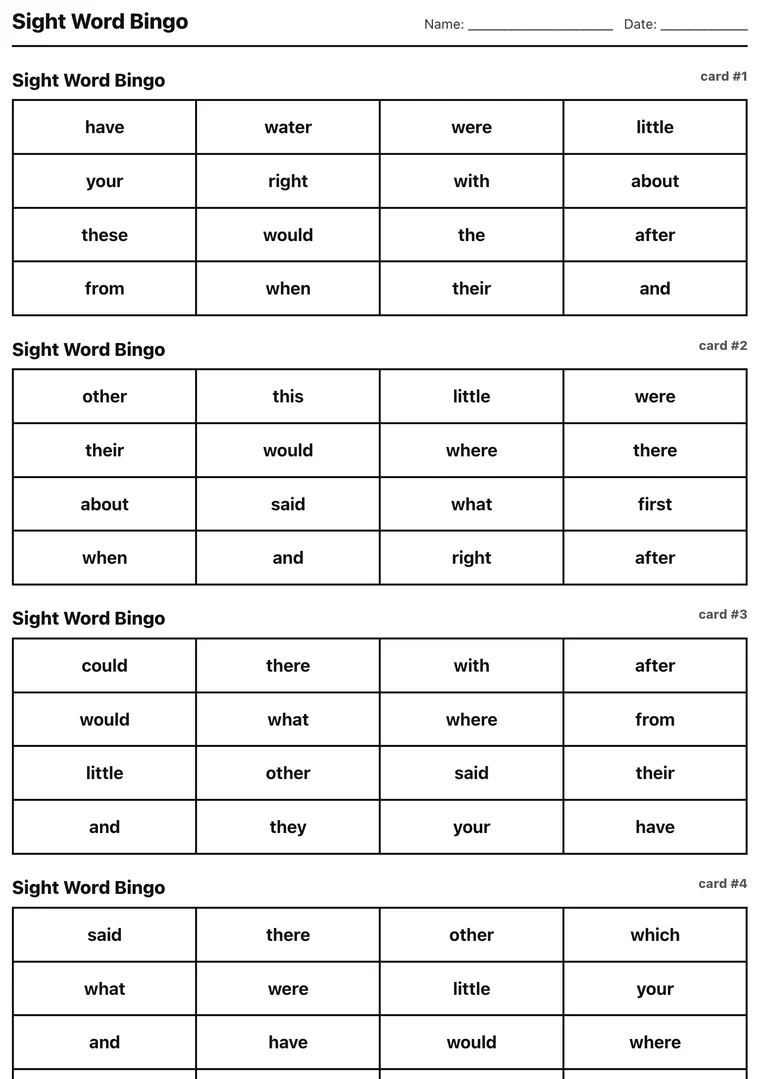
Sight words, math facts, Spanish vocabulary, baby shower prompts: paste your list, pick a grid, and print a whole set of cards where every card is shuffled differently. That last part is the point: identical cards ruin the game.
🖨️ Prints on one page ⚡ Instant preview 🆓 Free, no sign-up
What it prints
How to make a bingo card in 4 steps
- 1 Enter the item pool One per line. The pool has to be bigger than the grid: 32 items minimum for a 5x5, more if you can.
- 2 Set how many cards One per student. Every card gets its own shuffle, so nobody shares a layout.
- 3 Generate and print Two cards per page, which keeps a 5x5 readable at arm's length. Thirty students is fifteen sheets.
- 4 Keep the call list Print the item list for yourself and cross items off as you call them. Reconstructing a disputed win without it is impossible.
Every card is genuinely different
The generator shuffles the item pool separately for each card, so thirty cards means thirty different arrangements. That sounds obvious and it is the thing cheap bingo generators get wrong: printing the same handful of layouts means several students win on the same call, which ends the game early and badly.
Two cards printed per page, which is the density that keeps a 5x5 grid readable at arm's length while still fitting a class into fifteen sheets.
How many items you need in the pool
The pool has to be bigger than the grid or every card is the same set of items in a different order, and the game turns into a race to spot rather than a game of chance.
| Grid | Squares | Minimum pool | Comfortable pool |
|---|---|---|---|
| 3x3 | 9 | 12 | 18 or more |
| 4x4 | 16 | 22 | 30 or more |
| 5x5 with free space | 24 | 32 | 45 or more |
| 5x5 no free space | 25 | 34 | 48 or more |
Take the free space out
The centre free square is traditional and it is worth dropping in a classroom. It gives every card a guaranteed shared line through the middle, which means the middle row and column and both diagonals are all one square easier for everyone at once. Games end faster and more often in a tie.
Without it, a 5x5 card needs 25 items and the wins spread out. If you want a shorter game, shrink the grid to 4x4 instead of adding a free square.
Using it as a review activity rather than a filler
Bingo becomes a teaching activity the moment the caller stops reading the answer. Put the vocabulary words on the cards and call the definitions. Put the answers to multiplication facts on the cards and call the questions. Put French words on the cards and call the English.
The student then has to do the work to know whether they have the square, which is retrieval practice disguised as a game, and it is one of the few review formats a whole class will do willingly at the end of a Friday.
Practical notes: keep a printed call list and cross items off as you go, because reconstructing what you called during a disputed win is impossible. Call slowly enough for the slowest student to scan their card, which is slower than feels natural. And decide before you start whether a line, four corners or a full card wins, because deciding afterwards is how arguments start.
Running the game in a full classroom
The generator makes the cards. The part that decides whether it works is what happens in the twenty minutes afterwards.
Decide the winning pattern out loud before the first call: a line, four corners, or a full card. A line takes about five to eight minutes with a 5x5 grid, a full card takes twenty and will run past the bell. Deciding after somebody shouts is how a review game becomes an argument.
Use counters rather than pens if you want to run more than one round. Beans, cubes, torn paper squares, anything. Marked cards are single use and thirty fresh cards per round is a lot of printing for a Friday.
Call slower than feels natural. The pace should suit the slowest scanner in the room, which is roughly one item every eight to ten seconds if students have to work out the answer before checking their card. Calling fast turns a review activity into a listening test.
Keep the crossed-off call list. When two students claim a line at once, and they will, the list settles it in five seconds.
Frequently asked questions
How many items do I need for a good game?
More than the grid holds, or every card wins at once. For a 5×5 card (24 squares plus free space), aim for at least 35-40 items; for 3×3, a dozen will do. The generator warns you when your list is too tight for fair cards.
Can I print 30 different cards in one go?
Yes. Set how many cards you need and they all print in one job, two per page, each with its own shuffle. Every card also gets a small card number so you can verify a winning card afterward.
How do I use bingo for actual teaching, not just a party game?
Call the clue, not the answer. Say the definition and kids find the word; say '7×8' and they find 56; say the Spanish word and they find the English. The cards carry the answers, your calling carries the lesson.
Which grid size for which age?
3×3 for pre-K and kindergarten (fast games, big squares), 4×4 for early elementary, 5×5 with free space for everyone older: that's the classic format adults expect at showers and family nights too.
How many items do I need for a 5x5 bingo card?
At least 32, and 45 or more is better. A 5x5 card holds 25 squares, so a pool of exactly 25 gives every student the same items in a different order, which turns the game into a race rather than a game of chance.
Should the centre square be free?
In a classroom, no. A shared free centre makes the middle row, middle column and both diagonals one square easier for everybody at once, so games end early and often in a tie. Use a 4x4 grid if you want a shorter game.