🔗 Matching Worksheet Generator
Type your pairs (word and definition, country and capital, term and date) and get a worksheet with column A in order and column B shuffled, ready to connect with a pencil line.
🖨️ Prints on one page ⚡ Instant preview 🆓 Free, no sign-up
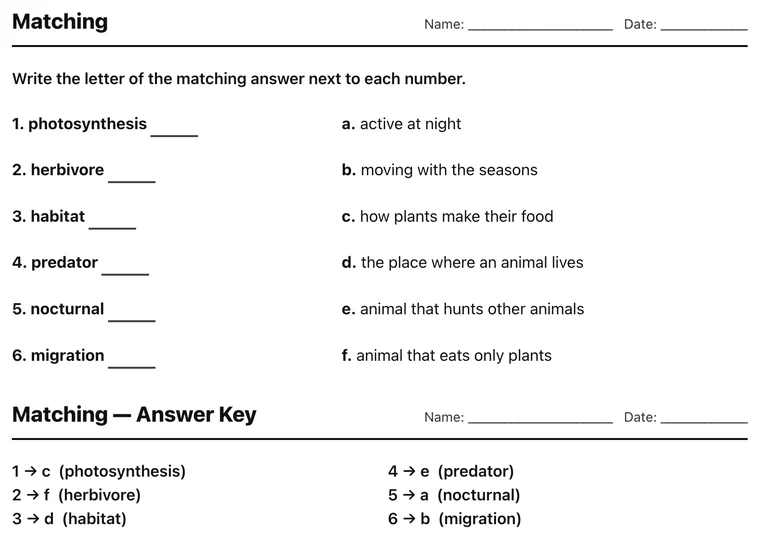
What it prints
How to make a matching worksheet in 4 steps
- 1 Enter the pairs Left item and right item on each line. Term and definition, word and translation, date and event, fraction and decimal.
- 2 Keep the list short Six to eight pairs for most ages. The last few pairs in a long list solve themselves by elimination.
- 3 Add extra items on the right Two plausible distractors close the elimination loophole and turn a guessable exercise into a real one.
- 4 Print with the key The right column is shuffled so nothing lines up with its own answer, which means you do need the key to mark it.
Why no item ever matches its own position
The generator shuffles the right column so that no row happens to line up with its own answer. That is a deliberate constraint and it is the difference between a real exercise and a free pass.
With a plain shuffle, roughly one item in a list of ten lands opposite its correct partner by chance. Students find those instantly, and worse, they start scanning for the accidental alignments instead of reading. Forcing a full derangement means every single line has to be worked out.
How many pairs before it stops working
Matching gets easier as it goes, because every pair solved removes a candidate from both columns. The last three pairs are usually free. That means long lists give an inflated sense of mastery.
| Age | Pairs | Note |
|---|---|---|
| 5 to 6 | 4 to 5 | Pictures or single words only |
| 7 to 8 | 6 to 8 | Short phrases on the right |
| 9 to 11 | 8 to 10 | Definitions can be a full sentence |
| 12 and up | 10 to 12 | Add two extra distractors on the right |
Add distractors to close the process-of-elimination hole
The cleanest fix for the free-pass ending is an unequal number of items: twelve on the right for ten on the left. Suddenly no pair can be deduced by elimination, and a student who genuinely knows eight out of ten scores eight instead of ten.
Two extra distractors is enough. They should be plausible, drawn from the same topic, not obviously silly. A joke distractor is a free elimination.
What matching is good at
Term to definition, word to translation, date to event, symbol to element, fraction to decimal, country to capital. Anything with a clean one-to-one relationship.
It is a recognition test, not a recall test, which makes it a gentler assessment than fill-in-the-blank. That is useful early in a unit and misleading at the end of one. If you want to know whether students can produce the term, matching will not tell you.
Keep the left column short and the right column long. Scanning ten long phrases against ten other long phrases is a reading-speed test in disguise, and it penalises exactly the students it should not.
Writing the right-hand column
The quality of a matching sheet is decided almost entirely by the right column. Two rules cover most of it.
First, keep the entries a similar length. If one definition runs to two lines and the rest are four words, students will pair the long one with the hardest term without reading either. Length becomes an unintended clue, and it is the most common way a matching sheet leaks answers.
Second, avoid repeating a distinctive word from the left item on the right. A definition of photosynthesis that contains the word photosynthesis, or a translation that shares a root with the original, can be matched without knowing anything. Rewrite the definition to describe rather than name.
For language pairs, watch cognates in the same way. If eight of ten French words look like their English equivalents, the sheet is testing spotting rather than vocabulary. Mix in the words that do not look alike, which are the ones worth practicing anyway.
Marking a class set quickly
Because the right column is shuffled, matching sheets cannot be marked by eye against the order you typed. Two habits make a class set take about four minutes.
Mark down the columns rather than across the rows. Reading one student's ten answers in order means holding ten pairs in your head; reading everyone's answer to item one first, then item two, means holding one. It is faster and noticeably more accurate.
Then read the pattern rather than the score. If twenty-four of thirty students missed the same pair, that is not a marking result, it is a reteaching instruction, and it is the only genuinely useful thing a matching sheet produces.
Frequently asked questions
How do I enter the pairs?
One pair per line, separated by a dash or an equals sign: 'photosynthesis = how plants make food'. The left side lands in column A, the right side gets shuffled into column B. Ten to twelve pairs fit nicely on one page.
Does the shuffle guarantee nothing lines up straight across?
Yes. A matching sheet where item 3 matches answer 3 gives itself away, so the generator reshuffles until no pair sits on its own row (with two pairs or fewer that's mathematically impossible, and it warns you).
What subjects does matching work best for?
Anything with a one-to-one link: vocabulary and definitions, historical figures and what they did, math terms and examples, foreign-language word pairs. It's weaker for concepts with fuzzy boundaries: those want short answers, not matching.
Is there an answer key?
Yes, on a separate page: each column A item with its correct letter. It prints after the worksheet so you can staple or withhold it, and you can turn it off.
Why is the answer key necessary if I wrote the pairs?
Because the right column is shuffled and never lines up with its own answer. That is what stops students spotting free matches, and it also means you cannot mark the sheet against the order you typed. The key shows the shuffled order.
Can I use pictures instead of words?
Not in the generator, but the standard workaround is to number the pictures on a separate sheet and match numbers to words. It keeps the matching logic intact and lets you use any images you already have.