🔤 Spelling Worksheet Generator
Paste this week's word list and get a practice page your students can actually use: trace the word, copy it, and fill in the missing letters. Pick the activities you want, print, done.
🖨️ Prints on one page ⚡ Instant preview 🆓 Free, no sign-up
Activities
What it prints
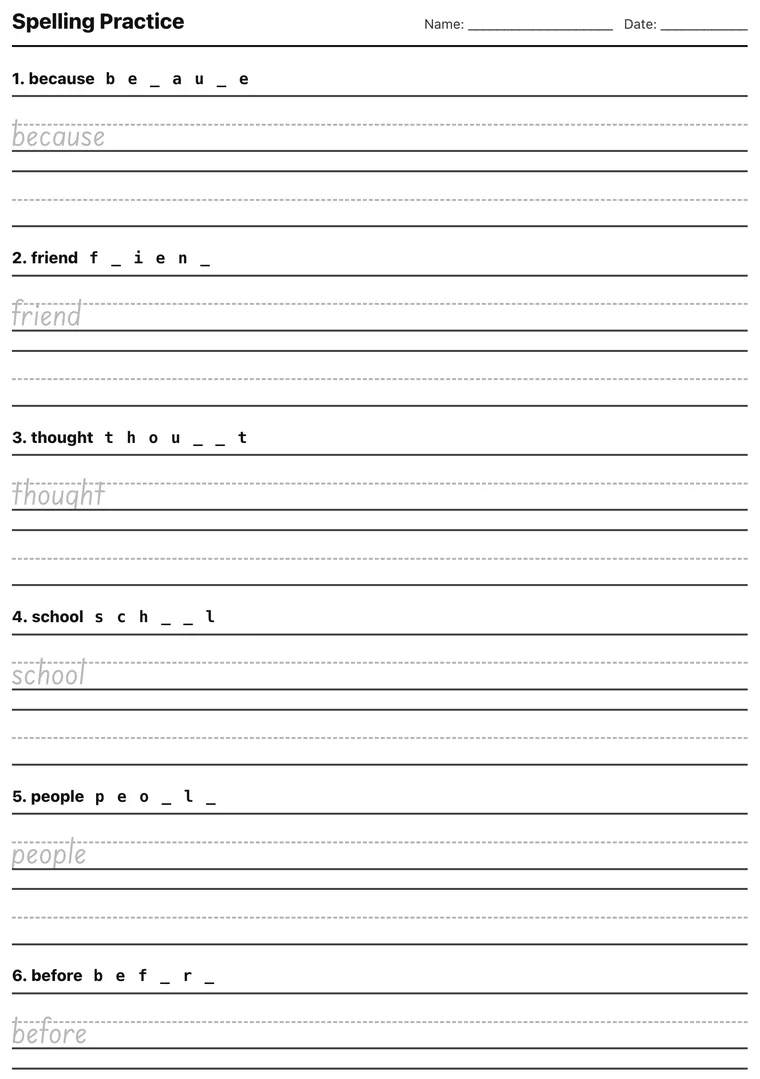
How to make a spelling worksheet in 5 steps
- 1 Paste this week's list One word per line. Any list works: phonics pattern, sight words, science vocabulary, or the six words a particular child keeps getting wrong.
- 2 Pick the activities Trace, copy, missing letters. Turn off the ones you do not need, because all three at once fills a page at eight words.
- 3 Check the preview The sheet on the right is exactly what prints. If the last word is falling off the page, remove a word or an activity.
- 4 Shuffle for a second version Reshuffling changes which letters get hidden, so the Friday sheet is not the Monday sheet with the same gaps.
- 5 Print or save as PDF Print sends only the worksheet, not the page around it. Choose Save as PDF in the print dialog to keep a copy.
How many words belong on one list
The most common mistake with spelling homework is length. A list of twenty words looks thorough and produces twenty words practiced badly. Fewer words, practiced three ways, beats a long list copied once.
These are the sizes that hold up across a normal mixed-ability class. If half the room is missing more than three words on Friday, the list was too long, not the students.
| Level | Words per list | What the list should be |
|---|---|---|
| Kindergarten | 5 to 6 | CVC words on one vowel sound: cat, hat, mat |
| 1st grade | 8 to 10 | One phonics pattern plus 2 sight words |
| 2nd grade | 10 to 12 | One pattern, plus words from the current unit |
| 3rd to 4th | 12 to 15 | Pattern words plus content vocabulary |
| 5th and up | 15 to 20 | Roots and affixes, not random hard words |
The three activities and when each one earns its place
The generator gives you trace, copy and missing letters. They are not interchangeable and printing all three for every list wastes paper.
Trace
Only useful the first time a student meets a word, or when handwriting is still the bottleneck. Past 2nd grade it becomes busywork: the hand moves, the spelling does not get encoded. Turn it off once the class can write the words unaided.
Copy
The workhorse. Writing a word from a model, then again without looking, is the closest a worksheet gets to the look-cover-write-check routine that actually moves scores.
Missing letters
The one that tests. It forces retrieval instead of transcription. Save it for midweek and Friday, when you want to know what stuck rather than keep the class busy.
Print two versions of the same list
The missing-letters activity hides a different set of letters every time you shuffle. That is deliberate. Print one sheet on Monday for practice and shuffle before printing Friday's, and students cannot pass by memorizing the shape of the blanks.
It also solves the neighbour problem without making two lists: two students sitting together get different gaps from the same words.
Words that break spelling worksheets
Any list works, but a few kinds of words produce a page that looks wrong. Words longer than about twelve letters push the trace row into a second line. Words with apostrophes print fine but the missing-letter activity may hide the letter next to the apostrophe, which reads as a typo to a seven year old.
Homophones deserve a rule of their own: never put there, their and they're on the same sheet. Practicing them side by side teaches the confusion rather than the distinction. Introduce one, wait a week, then contrast.
UK spellings pass through untouched. There is no dictionary behind the generator, so colour, practise and favourite print exactly as typed.
Where the list should come from
A spelling list assembled from a published scheme and never adjusted is the default, and it is the reason so many students score well on Friday and misspell the same words in their writing on Monday.
Three better sources, in order of usefulness. First, the words the class actually got wrong in their own writing last week. Nothing else is as well targeted, and collecting them costs nothing beyond a note while marking. Second, one phonics or morphology pattern at a time, so the list teaches a rule rather than twelve unrelated facts. Third, the vocabulary of whatever subject is being taught right now, which gets the spelling practice and the content revision out of the same sheet.
The test for whether a list was any good is not the Friday score. It is whether those words are spelled correctly in a piece of free writing three weeks later. If they are not, the list was memorised rather than learned, and the fix is usually spacing rather than more practice.
Frequently asked questions
How many words fit on one page?
It depends on which activities you turn on. With all three (trace, copy, missing letters), 8-10 words fill a page comfortably. With just one activity you can fit 15 or more. The preview shows exactly what will print, so add words until it looks right.
Can I use my own word list instead of a preset?
That's the whole point. Type or paste any list: this week's phonics pattern, sight words, vocabulary from your science unit, or your child's tricky words. One word per line, and the worksheet rebuilds instantly.
How does the missing-letters activity choose which letters to hide?
It removes roughly a third of the letters, never the first letter, and spreads the blanks out so the word stays recognizable. Every time you click Shuffle you get a different pattern, so you can print two versions of the same list for practice and for the test.
Does it work for UK spellings?
Yes. The generator prints exactly what you type: colour, practise, favourite. Nothing gets autocorrected to US spelling, because there's no dictionary behind it: your list is the source of truth.
Can I make a spelling worksheet for two different groups at once?
Make two sheets. It takes about thirty seconds each and a single sheet covering two ability groups ends up too hard for one and too easy for the other. Keep the activities the same and change the word list, so the page looks identical from across the room.
Is there a way to print without the answers showing?
The trace and copy activities show the word by design, because they are practice rather than assessment. For a version with nothing given away, use missing letters on its own: the word appears with gaps and no model above it.