📖 Vocabulary Worksheet Generator
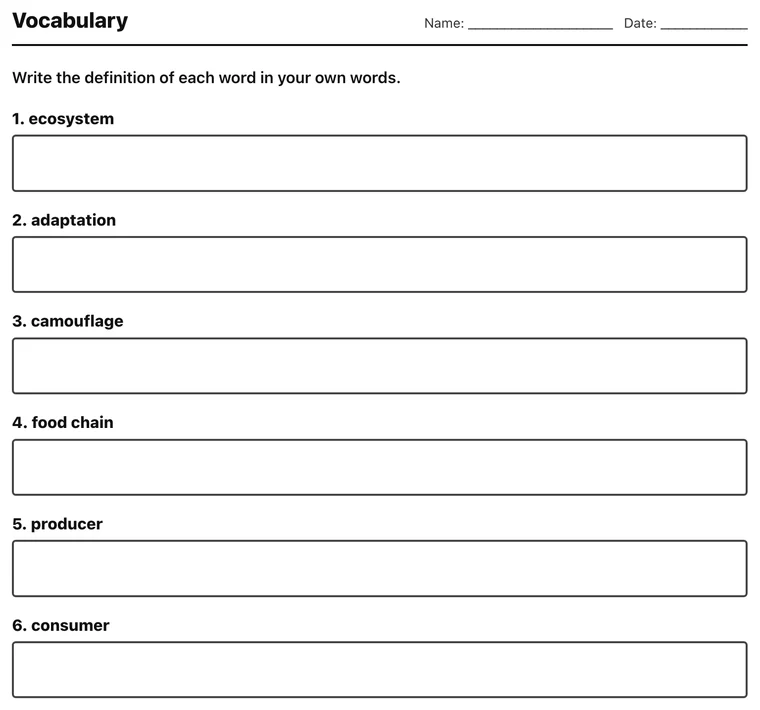
Paste the unit's vocabulary and choose the format: a define-it page with ruled boxes, or a use-it-in-a-sentence page with numbered lines. Plain, honest formats teachers have used forever: now without making the table in Word.
🖨️ Prints on one page ⚡ Instant preview 🆓 Free, no sign-up
Monday: define. Thursday: sentences. Same list, two very different exercises.
What it prints
How to make a vocabulary worksheet in 4 steps
- 1 Enter the words Eight to twelve for a new unit. Choose words the students will meet again, not the hardest words in the chapter.
- 2 Pick the mode Define for the introduction day, sentence for the work that actually teaches, study for retrieval a few days later.
- 3 Mix in older words Add a few words from last month. Spacing is the setting that moves vocabulary into long-term memory, and it costs nothing.
- 4 Print or save as PDF Save the study version as a PDF and reprint it in three weeks as a warm-up.
Definitions are the weakest way to learn a word
Copying a dictionary definition is the default vocabulary homework and it is close to useless. Students can reproduce a definition for a word they cannot use in a sentence, cannot recognise in a text, and will not remember in a month.
The reason is that a definition gives you the word in isolation. Word knowledge is mostly knowledge of company: which words it sits next to, what kind of sentence it belongs in, whether it is formal or casual.
This is why the generator offers three modes, and why the define mode is the one to use least.
Define
Fine as a first pass on the day the word is introduced. Keep the definition to one line in the student's own words. A copied dictionary entry is worse than nothing.
Sentence
The one that works. Writing the word in a sentence that shows the meaning forces the student to commit to how it is used. Insist the sentence gives a clue to the meaning: 'The weather was inclement' proves nothing.
Study
The retrieval pass. Word on one side, nothing on the other. Use it two or three days after introduction, not the same day, because spacing is what moves words into long-term memory.
How many words per unit
Between eight and twelve new words a week is the range where retention holds. Beyond that, the extra words displace the earlier ones rather than adding to them.
Choose words by usefulness rather than by difficulty. A word that appears across many texts is worth ten times a word that appears once in the chapter you are reading. The test is whether the student will meet it again this year.
Three categories are worth separating: everyday words the student already uses, high-utility academic words like analyse, contrast and significant, and technical words specific to the subject. The middle group is the one that repays teaching and the one most often skipped.
Spacing beats volume
The single highest-leverage change to vocabulary homework is to stop testing on Friday what you introduced on Monday, and start testing on Friday what you introduced three weeks ago.
A practical rotation that fits on one sheet: half the words from this week, a quarter from last week, a quarter from a month ago. The old words take almost no extra time because they are mostly known, and each retrieval pushes them further into memory.
Print the study mode of an old list as a warm-up rather than a test. Five minutes, no marks, no stakes. The retrieval is doing the work whether or not it is graded.
What a good student sentence looks like
The sentence mode only works if the sentence proves the student knows the word, and the default student sentence proves nothing. Setting one rule fixes most of it: the sentence has to give a reader who does not know the word a clue to what it means.
Compare two sentences for the word inclement. 'The weather was inclement' is empty and would earn a tick from a tired marker. 'The match was called off because the weather was inclement, with hail coming in sideways' shows the meaning. The second sentence is barely longer and it is the whole exercise.
The failure modes worth naming for students: the empty sentence above, the sentence that just restates the definition, and the sentence where the word could be swapped for almost any other word of that type without anything changing. If a sentence still works with the word replaced by thing or nice, it does not count.
For younger students, ask for a because. Forcing a subordinate clause tends to drag the meaning out of hiding, and it produces a sentence you can mark in two seconds.
Frequently asked questions
Which format should I pick?
Define-it works when kids have a glossary or dictionary to consult, it's a lookup-and-restate exercise. Sentence-writing is harder and shows whether they actually own the word. A common week: define on Monday, sentences on Thursday, same list.
How many words per worksheet?
Six to eight for definition boxes (they need writing room), up to ten for sentence lines. Past that the boxes shrink to a size where kids write four-word definitions, which defeats the purpose. Split long units across two sheets.
Can I include the definitions myself and make it a study sheet?
Yes. Add a definition after each word with a dash and the sheet prints them under each term as a reference page instead of an exercise. Print one of each: study sheet first, blank sheet after.
Does this work for older grades or just elementary?
The formats are age-neutral: a 9th grade biology list works exactly like a 2nd grade sight word list, just with harder words. What changes is your list, not the sheet.
Should students copy dictionary definitions?
No. A copied definition can be reproduced by a student who cannot use the word, recognise it in a text or remember it next month. A one-line definition in their own words plus a sentence that shows the meaning is worth more than a paragraph copied out.
How many vocabulary words per week?
Eight to twelve. Beyond that the extra words displace the earlier ones rather than adding to them. If you need to cover more, rotate older words back in instead of lengthening the new list.