✒️ Cursive Worksheet Generator
Cursive still gets taught, and tested, in plenty of schools, and most free sheets only cover the alphabet. This one takes your words: spelling lists, names, or the quote your class is copying.
🖨️ Prints on one page ⚡ Instant preview 🆓 Free, no sign-up
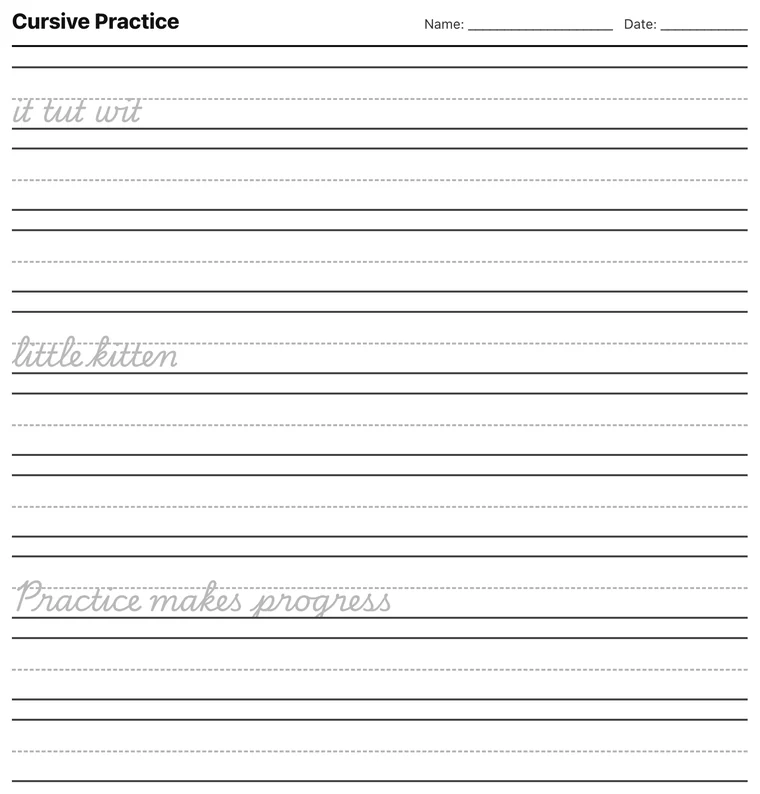
Start with the undercurve family (i, t, u, w): one shared stroke, quick wins.
What it prints
How to make a cursive worksheet in 4 steps
- 1 Type or paste the text Words on the early sheets, whole sentences once joins are secure. A paragraph from the book the class is reading works better than a made-up sentence.
- 2 Add blank rows Model on one line, blank underneath. Copying under the model is where cursive is actually learned.
- 3 Check the joins in the preview The preview shows the real joined letterforms, so you can see whether a word is going to be legible before you print thirty copies.
- 4 Print or save as PDF Print at Actual Size. Fit to Page shrinks the letters and the line height stops matching the age you set it for.
When cursive is worth starting
The honest answer is late second grade at the earliest, and only once print is automatic. A child still thinking about how to form a print letter has no attention left for joining.
The case for teaching it at all is weaker than its defenders claim and stronger than its critics allow. Speed is the real argument: a fluent cursive or semi-joined hand is faster than printing, and that matters for any student who still handwrites exams. The memory and dyslexia claims are mostly overstated.
The practical middle ground most schools land on is a joined but simplified hand: join the easy letters, print the awkward ones, do not fight over loops.
Teach the joins, not the alphabet
Cursive is not print with tails. It is a set of four joins, and once a student owns the joins they can write any word. Teaching letter by letter in alphabetical order produces students who can write the alphabet and not a sentence.
| Join | Example | Why it comes in this order |
|---|---|---|
| Base to base | in, an, un | Both letters sit on the line. The simplest case. |
| Base to top | ch, th, sh | The exit stroke has to climb. Introduces height control. |
| Top to base | or, ov, wn | Starts from an o or w exit, which sits high. |
| Top to top | oo, wh, vi | Two high exits in a row. Leave until last. |
Slant comes from the paper, not from the wrist
When cursive looks wrong but the letters are correct, the cause is almost always the angle of the paper. Children are told to slant their writing and try to do it by twisting the wrist, which tires the hand in about four minutes and produces a wobbling line.
The fix is to turn the page instead. A right-handed writer tilts the paper roughly 30 degrees counter-clockwise, so the bottom left corner points at the belly button; a left-handed writer tilts it the same amount the other way. The forearm then travels in a straight line and the slant appears on its own.
Two things to check before blaming the child: both feet should reach the floor, and the non-writing hand should be holding the paper still. A page that slides around gets rewritten crooked no matter how good the letters are.
The letters that cause the trouble
Four letters account for most cursive frustration. Practice them separately rather than hoping they resolve inside words.
The letter r is the worst offender: its exit sits at mid height and students either flatten it into an n or overshoot into a v. The letter s has a top exit that most children turn into a closed loop. The letter b joins from the top and constantly gets read as an l with a bump. And f is the only letter with both an ascender and a descender, so it collides with the lines above and below.
A useful drill is to write the same word with each problem letter in the middle: bring, first, class, before. Isolated letter practice does not expose the join, which is where the letter actually goes wrong.
Sensible content for cursive practice
Pangrams are traditional and mostly useless. The quick brown fox contains every letter, which means it contains the rare ones at the same rate as the common ones, so students spend equal effort on q and on e.
Better material, in order of usefulness: the student's own name and address, high frequency words, then sentences from whatever they are reading in class. Copying a sentence they understand keeps attention on the hand rather than on decoding.
For older students and adults, copy work from a book they like beats any worksheet sentence. The generator takes pasted text, so a paragraph from the actual book is one paste away.
Adults relearning cursive
A large share of people looking for cursive practice are adults, not children, and the approach that works is not the school one.
Skip the letter drills. An adult already has the motor control a child is building; what has usually gone is consistency, not capability. Copying continuous text at normal size fixes that faster than pages of isolated letters, and it is far less tedious, which matters because the whole thing depends on doing it regularly.
Slow down before anything else. Most adult handwriting complaints are a speed problem wearing a legibility costume. Write a paragraph at roughly half your normal pace and the letterforms usually reappear on their own, which tells you the shapes are still in there.
Pick the joins you actually want. Full traditional cursive with every letter connected is not the goal for most adults. A part-joined hand, connecting the easy pairs and lifting the pen for the awkward ones, is faster and more legible than either extreme.
Ten minutes a day for a month will do more than a weekend of intensive practice. Paste a paragraph you like into the generator, print a week's worth, and keep the pages so the change is visible.
Frequently asked questions
Which cursive style is this?
A clean, modern school cursive with entry and exit strokes, closest to the simplified styles most curricula use today. It's not ornate copperplate: the goal is letterforms a 3rd grader can actually reproduce.
What order should kids learn cursive letters in?
Not alphabetical. Most programs start with the undercurve family (i, t, u, w) because they share one stroke, then build letter families from there. A good use of this tool: make one sheet per family: 'it, tut, wit': instead of random words.
Can I make a sheet of cursive capital letters?
Yes, just type them. Capitals are genuinely harder (many don't connect to the next letter), which is why schools teach them last. Names are the classic capital practice: one capital, then lowercase flow.
At what age do schools teach cursive?
Where it's taught, it usually starts in 2nd or 3rd grade, after print is automatic. More than 20 US states have brought cursive requirements back into their standards, which is why parents suddenly need sheets their school doesn't send home.
At what age should cursive start?
Late second grade at the earliest, and only when printing is automatic. A child still working out how to form a print letter has no capacity left for joining. Starting a year late costs nothing; starting a year early produces a hand that has to be untangled.
Do I need to teach capital letters in cursive?
Only a handful, and late. Cursive capitals are decorative, rarely joined to the next letter, and several of them look nothing like their print versions. Teach the initials the student actually needs, their own name first, and leave the rest.