🔀 Word Scramble Worksheet Maker
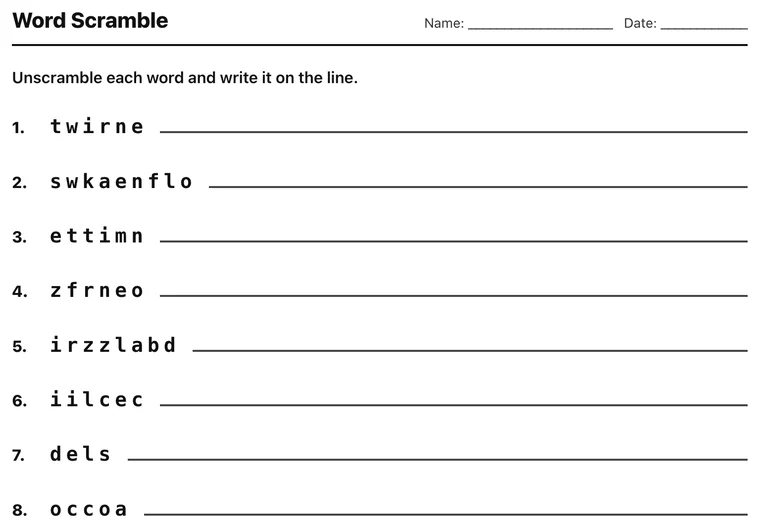
Every word in your list gets shuffled into nonsense, with a line to unscramble it. Add hints for younger kids or leave it bare for a challenge: either way it's a one-page print.
🖨️ Prints on one page ⚡ Instant preview 🆓 Free, no sign-up
What it prints
How to make a word scramble in 4 steps
- 1 Enter the words Words the students already know how to spell. Scrambling brand-new vocabulary produces guessing, not practice.
- 2 Watch the length Under six letters works unaided. Past that, include a word bank or the task becomes brute force.
- 3 Reshuffle any word that came out wrong Randomness occasionally produces a scramble that is nearly the original word, or one that spells a different real word. Shuffle again.
- 4 Print or save as PDF The answer key prints separately so you are not marking from memory.
The difficulty is in the letter count, not the word
Unscrambling difficulty scales roughly with the number of possible arrangements, which grows fast. A four-letter word has 24 orderings. A seven-letter word has 5,040. That is why a scramble that feels fine for you is impossible for an eight year old.
| Letters | Orderings | Realistic for |
|---|---|---|
| 3 to 4 | 6 to 24 | Age 5 to 6, with a picture clue |
| 5 to 6 | 120 to 720 | Age 7 to 8, words they already know |
| 7 to 8 | 5,040 to 40,320 | Age 9 to 11, with a word bank |
| 9+ | over 360,000 | Only with a word bank or a clue |
Always give a word bank past six letters
A scramble without a word bank is a recall task with no route in. Past about six letters, a student who does not immediately see the word has no strategy left except brute force, and brute force at 5,040 orderings is not a strategy.
With a word bank the task changes into something useful: matching a set of letters against a set of candidates, which is exactly the skill that helps with spelling. The scramble becomes a check on whether they know the letters in the word rather than a lottery.
The exception is a review sheet where every word came from the same lesson that morning. Then the lesson is the word bank.
Scrambles that are accidentally unsolvable
Two failure modes worth knowing before you print. First, a scramble that comes out as another real word: EARTH scrambled to HEART is not wrong, but both answers are defensible and you will spend the marking arguing.
Second, a scramble that comes out nearly unscrambled. Randomness does that occasionally, and a word missing one swap reads as a typo rather than a puzzle. Shuffle again if a word looks too close to the original.
Double letters make a scramble easier than its length suggests, because two identical letters cut the real number of arrangements in half. BALLOON is a seven-letter word that behaves like a five-letter one.
Good uses beyond the vocabulary list
Scrambles work well for anything where the spelling is the point and the meaning is already known: the names of the planets, the states, the bones of the arm, the characters in the book. The student knows what the answer should be and is being asked to reconstruct how it is written.
They work badly for new vocabulary. Scrambling a word a student met ten minutes ago is asking them to spell something they have not learned to spell, which produces guessing.
Making the sheet easier without shortening the list
When a scramble is too hard, the instinct is to cut the number of words. That is the one change that does not help: fewer words means the same impossible task repeated fewer times.
The adjustments that actually change difficulty, in order of effect:
Shorten the words
The biggest lever by far, because the number of possible orderings grows factorially with length. Swapping an eight-letter word for a five-letter one cuts the search space from 40,320 to 120.
Add a word bank
Turns an open search into a matching task. This is the difference between solvable and not for most students past six letters.
Give the first letter
Printing the first letter in place removes most of the false starts, because students naturally try to build from the front.
Group by topic
Telling students all ten words are planets narrows the candidates before they touch a letter. Free, and it keeps the vocabulary in play.
Frequently asked questions
Will short words scramble properly?
Three-letter words only have a few arrangements, so the tool guarantees the scramble never equals the original word, 'cat' will never come out as 'cat'. Two-letter words are rejected outright because there's nothing to solve.
What are the hints and when should I use them?
The optional hint column shows the first letter of the answer. Use it for K-2 or for content vocabulary kids have only seen a few times. For spelling review with familiar words, leave hints off: recalling the word is the exercise.
Why do teachers use scrambles instead of just a spelling test?
A scramble forces kids to hold the letters in mind and test arrangements against words they know, it's spelling practice disguised as a puzzle. It also self-checks: if the letters don't all get used, the answer is wrong, no teacher needed.
Can I reshuffle the same list for a second version?
Yes. One click gives every word a fresh scramble, so row one of Monday's sheet doesn't match row one of Friday's. Handy for take-home versus in-class copies too.
How do I make a word scramble easier?
Shorten the words before anything else, because difficulty scales with the number of possible orderings and that grows very fast with length. After that, add a word bank, then add first-letter hints. Reducing the number of words does almost nothing.
Can I use phrases instead of single words?
You can, but scramble each word separately rather than scrambling the whole phrase. A scrambled phrase has too many arrangements to be solvable and students end up guessing at the word boundaries instead of the spelling.