➕ Math Worksheet Generator
Pick the operation, set the number range, and get a page of practice problems with an answer key. It's deliberately simple: fact fluency pages, the kind kids burn through daily: not word problems.
🖨️ Prints on one page ⚡ Instant preview 🆓 Free, no sign-up
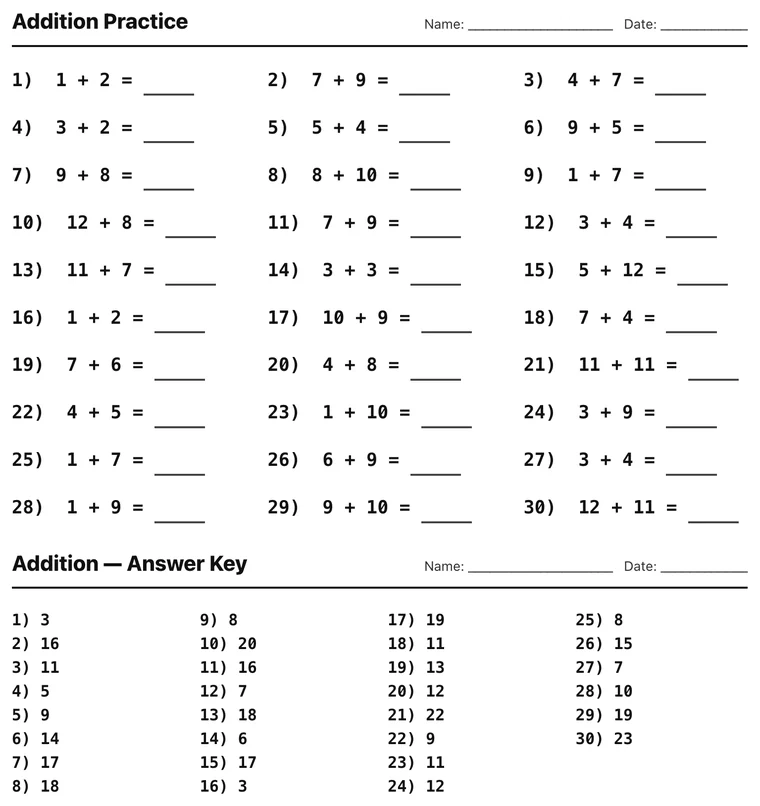
What it prints
How to make a math worksheet in 4 steps
- 1 Choose the operation Addition, subtraction, multiplication or division. One operation per sheet for fluency, mixed only for review.
- 2 Set the number range Match the grade, not the ambition. Within 20 for first grade, within 100 for second, tables to 10x10 for third.
- 3 Set how many problems Thirty to forty for a timed fluency page, six to ten if students are showing their working.
- 4 Reshuffle for a second sheet Same skill, different numbers. Print Monday's and Friday's from the same settings for a clean before and after.
Number ranges that match the grade
Most math worksheets fail on range rather than operation. A page of addition to 100 given to a first grader is not harder practice, it is a different skill they have not been taught.
| Grade | Add and subtract | Multiply and divide |
|---|---|---|
| Kindergarten | Within 10 | Not yet |
| 1st grade | Within 20 | Not yet |
| 2nd grade | Within 100 | Groups of 2, 5, 10 |
| 3rd grade | Within 1000 | Tables to 10x10 |
| 4th grade | Multi-digit | 2-digit by 1-digit, division with remainder |
| 5th grade | Decimals | 2-digit by 2-digit, long division |
Subtraction never goes negative and division always comes out whole
Both are deliberate. A subtraction worksheet for a seven year old that produces 4 minus 9 teaches nothing except that the sheet is broken, and a division sheet with a remainder the student has not been taught to write yet produces the same effect.
So the generator swaps the operands when it needs to, and picks divisors that divide evenly. If you want remainders or negatives, they are a separate skill and deserve a separate sheet rather than an ambush inside a fluency page.
Fluency practice and problem solving are different sheets
This is the distinction that decides how many problems belong on a page. Fluency is about speed and automaticity: 30 to 40 short problems, timed, aiming for recall rather than calculation. Problem solving is about method: 6 to 10 problems, untimed, with room to show working.
Mixing them produces the worst of both. A page of 40 problems with space to show working takes an hour and nobody finishes. A page of 8 problems for fluency practice does not build fluency.
Take a position on timed drills, since they are unfashionable: they work for basic facts and they are counterproductive for anything else. Knowing 7x8 without calculating frees up working memory for the actual problem. Timing a student on multi-step word problems just teaches them to panic.
How many problems fit, and how to mark them fast
In two columns, about 30 problems fit comfortably on a page with room to write the answer. In three columns you can push to 45, but only for single-digit work: multi-digit problems need the width for the working.
Print the same sheet twice with a reshuffle for a Monday-Friday pair. The numbers change, the skill does not, and you get a clean before and after without writing two sheets.
For fast marking, keep the answer pattern in mind rather than the answers: on a page of addition within 20, scan for answers over 20 or under the larger operand. Most errors are visible without doing the arithmetic.
Reading the errors on a marked sheet
A stack of marked worksheets is diagnostic information and most of it gets thrown away. Errors cluster in patterns, and the pattern tells you what to reteach.
An answer that is out by exactly ten on a two-digit addition is a carrying error, not an addition error: the facts are known and the place value is not. An answer that is out by one, repeatedly, usually means counting on fingers with an off-by-one start rather than recall. Answers that are wildly wrong on some problems and correct on others point at specific unknown facts, and the ones that recur are worth listing.
Subtraction errors have a signature of their own. A student who consistently subtracts the smaller digit from the larger regardless of position, so 52 minus 27 becomes 35, has learned a rule rather than the operation. That is worth catching early because it survives for years and produces plausible-looking wrong answers.
None of this shows up if you only record the score. Marking with a note of which problems failed, rather than how many, takes about the same time and is the difference between a grade and a plan.
Frequently asked questions
Can I control the difficulty exactly?
You set the range for each operand: say, 2 to 9 for both factors of multiplication, or up to 20 for addition. Subtraction never goes negative and division always comes out whole, so every problem is grade-appropriate by construction.
How many problems per page?
Choose 20 (large print, K-2), 30, or 40 (compact, for timed fluency drills). The classic 'mad minute' format is 30-40 problems in one to five minutes, and this prints exactly that.
Will two prints give the same problems?
No. Every generation draws fresh numbers, so Monday's sheet and Tuesday's sheet differ even with identical settings. If you need the same sheet twice, print two copies before regenerating.
Why fact fluency sheets and not word problems?
Because fluency is the part that needs volume. Kids need dozens of reps to make 7×8 automatic, and automatic facts are what free up working memory for the actual thinking in word problems. Generators are good at volume; word problems deserve a human.
Can I get subtraction problems with negative answers?
Not from this generator. It swaps the operands so the answer is never negative, because a page of fluency practice is the wrong place to meet negative numbers for the first time. Negatives are a separate skill and deserve their own sheet.
How many math problems should be on one page?
Thirty to forty for timed fact fluency, where the goal is recall. Six to ten if students are showing their working. Mixing the two produces a page nobody finishes and no useful information about what they know.