✏️ Name Tracing Worksheet Generator
The first word every child learns to write is their own name. Type it once and get a full page of practice lines: big traceable letters on real handwriting guides, sized for little hands.
🖨️ Prints on one page ⚡ Instant preview 🆓 Free, no sign-up
Tip: the default (capital first letter, lowercase after) matches how most kindergarten programs teach name writing.
What it prints
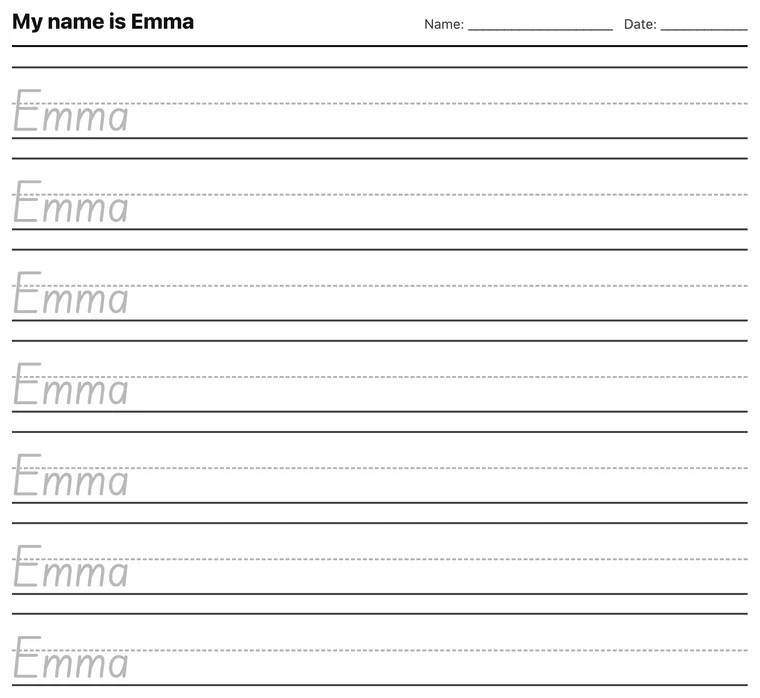
How to make a name tracing worksheet in 4 steps
- 1 Type the name Capital first letter, lowercase for the rest. Type it the way you want the child to write it, because that is exactly what prints.
- 2 Set the letter size Bigger for younger. A four year old needs letters that fill the line; shrinking them early makes the task harder, not more advanced.
- 3 Choose how many lines A full page for a first attempt, half a page once the name is coming along. A page of twelve rows is too much for one sitting at any age.
- 4 Print or save as PDF Print on plain paper for daily practice, or on cardstock and into a sleeve if you want it reusable with a dry-wipe pen.
Capital first, then lowercase, and never all capitals
A child who learns to write ELLA in block capitals has to unlearn it. Nurseries default to all caps because capitals are easier shapes, and then first grade spends a term undoing it.
The correct target from the start is title case: one capital, the rest lowercase. Ella, not ELLA. It is harder for a month and saves a year.
If a child genuinely cannot form lowercase yet, practice the capital letter alone rather than the whole name in caps. The initial is a real milestone and it does not teach a habit you will have to break.
Letter size by age
Small letters are not a sign of progress, they are a sign of a child compensating for poor control by reducing the movement. Start large and shrink over years, not weeks.
| Age | Letter height | What to expect |
|---|---|---|
| 3 to 4 | Whole line, about 25mm | Shapes will overshoot the guides. Fine. |
| 4 to 5 | Two thirds of the line | Capital touches the top, lowercase reaches the dotted middle. |
| 5 to 6 | Standard ruled line | Ascenders and descenders start landing correctly. |
| 6 and up | Narrow line | Only once the letters are consistently formed, not before. |
Signs a child is ready, and signs they are not
Name writing is usually pushed a year too early. The prerequisites are physical, not academic: a child needs to be able to copy a vertical line, a horizontal line, a circle and a cross before letters make any sense. Those four shapes cover the strokes in most letters.
If a child cannot copy a cross, more name practice will not help. Line tracing and shape tracing will. Pushing letters at that stage produces a fist grip and a child who decides early that writing is something they are bad at.
The useful signal that it is working: the child starts writing their name unprompted on drawings. That is worth more than a neat worksheet.
Print one sheet, use it twenty times
Name tracing is the one worksheet a child repeats daily for weeks, and printing a fresh copy every morning is a waste of paper and of your time. Slide the sheet into a clear plastic pocket and hand over a dry-erase marker. It wipes off with a sock, and most children will do three or four rounds in a sitting precisely because rubbing it out is part of the fun.
There is a second reason to do it this way. On paper, a mistake is permanent and a four year old who has just ruined their name will stop. On a wipeable sheet the same mistake costs two seconds, so they keep going, and the practice that matters is the repetition rather than the finished page.
Keep one printed paper copy for the last attempt of the week. That one goes on the fridge, and it is also the only honest record of whether the writing is actually improving.
Long names, hyphens and second names
Names longer than about ten characters shrink to fit the line, which defeats the purpose. For a long name, practice it in two halves for a few weeks: the first four or five letters on one sheet, the rest on another, then the whole thing.
Hyphenated and two-part names print as typed, including the space. A space is a real part of writing a name and children skip it constantly, so leaving it in the practice is correct.
Accented characters print correctly. José, Chloé and Zoë keep their marks, which matters more than it sounds to the child whose name is always spelled wrong.
Practice that beats another worksheet
Name tracing works best as a short daily habit inside a wider set of activities, not as the whole diet. A child who traces their name twice a day for a week and never writes it anywhere else does not really own it yet.
Cheap variations that use the same name and build the same motor pattern: write it in a tray of sand or salt with a finger, form it in playdough, paint it large on an easel, chalk it outside, spell it aloud while writing. Large muscle movements first, then the pencil.
The transfer test is whether the name appears without being asked: on a drawing, on a birthday card, on the front of a book. That is the point at which the tracing sheets have done their job and can stop.
One practical trick worth the ten seconds: print one sheet, slide it into a plastic sleeve, and use a dry-wipe pen. The same sheet takes a fortnight of daily practice instead of a day, and children who resist worksheets are noticeably more willing when the mistakes wipe off.
Frequently asked questions
What size are the letters?
You choose: large (about 1 inch tall, right for pre-K and kindergarten first attempts) or standard (for kids who already control the pencil and need repetition, not size). Both use the classic three-line guide with a dashed midline.
Can I put more than one name on the page?
Yes. Type several names separated by commas and the page alternates them, one per line. Useful for siblings sharing a sheet, or for practicing first and last name together.
Should my child trace in uppercase or lowercase?
Most US kindergarten programs teach names with a capital first letter and lowercase for the rest, which is this tool's default. If your school does all-caps first (some pre-K programs do), there's a toggle for that: just know they'll relearn it later.
How many times should a child practice their name per sheet?
Little and often beats one long session. One page (8-10 repetitions) a day is plenty; stop while it's still going well. If the letters fall apart halfway down the page, that's fatigue, not lack of ability: shorter sessions fix it.
Should I use dotted letters or grey letters for tracing?
Grey solid letters for a first attempt, dotted once the shape is familiar. Dotted lines ask the child to join up as well as follow, which is a second task. Starting with dots is one of the reasons early tracing looks so wobbly.
My child writes their name backwards. Is that a problem?
Reversed letters are normal up to about age seven and are not a sign of dyslexia on their own. What helps is a consistent starting point: most reversals come from starting the letter in the wrong place, not from seeing it backwards. Watch where the pencil lands first.